Dhiyanesh Ravichandran.
As a student of Sociology, I always wonder how my personal world views affect my perspective of looking at the same world, or for that matter, anything of social importance. When I study the increasing trend of product twins in our Indian car market, I invariably landed-up thinking that it is nothing but a cunning strategy of auto-makers to increase revenue by reducing the cost-per-unit due to common production. My notion that the corporates exploit people to amass profits applies here clearly. But I’m not sure of my causation and reasoning, because there are several other factors that I may have ignored. Though we like or not, we tend to use our ideologies or preconceived notions to comprehend things while studying them, which ultimately bias our study. The world views of individuals certainly affect their own perspectives of looking at the world.
As a student of Sociology, I always wonder how my personal world views affect my perspective of looking at the same world, or for that matter, anything of social importance. When I study the increasing trend of product twins in our Indian car market, I invariably landed-up thinking that it is nothing but a cunning strategy of auto-makers to increase revenue by reducing the cost-per-unit due to common production. My notion that the corporates exploit people to amass profits applies here clearly. But I’m not sure of my causation and reasoning, because there are several other factors that I may have ignored. Though we like or not, we tend to use our ideologies or preconceived notions to comprehend things while studying them, which ultimately bias our study. The world views of individuals certainly affect their own perspectives of looking at the world.
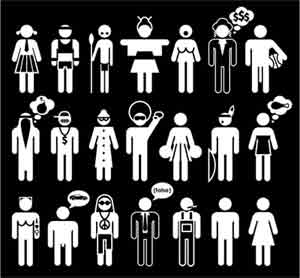 |
| We may have different perceptions about people around us |
While analysing the ideological bias, to which every researcher is guilt of, it is imperative for us to unravel what an ideology is, what constitutes it and how it is formed. An Ideology is usually taken to mean, a prescriptive doctrine that is not supported by rational argument (D.D. Raphael: 1970). The word ‘prescriptive’ in the definition makes ideologies customary, which is based on or authorised by long-standing custom. It is a consistent set of ideas related to every aspects of society that is manifested by different sources of knowledge. Earl Babbie lists out some ten types non-scientific thinking – Knowledge based on tradition, authority, casual observation, over generalisation, selective observation, qualification, illogical reasoning, ego-defense, premature closure of enquiry, and mystification. Such a variety of sources help us formulate something called an ideology or ideologies, which differs from individuals ostensibly.
Let us examine briefly how such manifestation of ideas that takes place every day within us, influence our understanding of the society. Experiences prevent us from seeing things, based on our assumption and confidence that we have a clear understanding of things. But reality is not just a thing ‘out there’, so that we can learn to perceive that objectively. All that’s “real” are the images that we got through our points of view. Put differently, there’s nothing “out there”; it’s all “in here” (Earl Babbie). Experiences and our ideas helps determine how we perceive reality – what patterns we see in analysis society and whether we are able to see patterns at all. Such experiences filter our perceptions of reality which, according to me, is one of the major problems of sociological research. How?
Real life experiences and passion of sociologists motivate much research – defining the research problem, what are all the units to be analysed, what are all the evidences to be reviewed, formulating causal hypothesis, etc. Merton believes that the very choice of topic is influenced by personal preferences and ideological biases of the researcher. It is nothing but his values that help him decide which problems are worth investigating. “We choose to study only those segments of reality which have become significant to us because of their value relevance” says Max Weber. What is one’s outlook towards class, caste, race, gender, religion, etc.? Is he dogmatic or more liberal? Such values lead Sociologists and researchers to formulate and adopt favoured theories for interpreting and explaining causation and conclusion. Does he subscribe to the Functionalist school of thought or any other? Every sociological theory is produced by and limited to a particular group whose viewpoints and interests they represent. Thus formulation of hypotheses will automatically introduce a bias in the sociological research.
Interpretations are also highly influenced by previous researches or theories on the same area. Sociologists consult earlier researches in order to find out what we already know and what is ought to be analysed? Sometime researchers adopt similar strategies or approach partly because of its familiarity. This sort of bias is prominent in physical sciences too. In astrophysical debates on the ‘Theory of everything’ in understanding the driving force of the universe, some scientists believe in the existence of some enigmatic dominant cosmic force called ‘dark energy’. Another school of scientists including world-renowned theorists Stephen Hawkins have spent years in disproving such forces. But there have been compelling evidences and findings which reveal the working of such enigmatic energy. This is a huge embarrassment for astronomers, who have long believed that the most important force in the cosmos is the same one that Isaac Newton supposedly saw pull an apple from a tree some 350 years ago – but no longer. Until this new breakthrough, researches and theories were based on the gravitational force hypothesis, but now it is a very different story.
The methods that researchers use to gather data mold their perceptions – shape of their research tool often help to determine which bits of reality they dig up. Those methods influence the researcher’s accessibility to various aspects of reality. In case of interview as a technique the data may be influenced by context of the interview, the interaction of the participants, and participant's definition of the situation and if adequate rapport does not extend between them there might be communication barriers. Thus according to P.V Young, interviews sometimes carry subjectivity. Finally, it can also affect the field limitations as reported by Andre Beteille’s study of Sripuram village in Tanjore, where the Brahmins did not allow him to visit the untouchable locality and ask their point of view.
The impact of ideological biases on sociological research can be very far-reaching as seen from the study of Tepostalan village in Mexico. Robert Redfield studied it with functionalist perspective and concluded that there exists total harmony between various groups in the village while Oscar Lewis studied this village at almost the same time from Marxist perspective and found that the society was conflict ridden. Subjectivity creeps in at different stages of their studies. It is impossible to ignore that their observations as unreal.
Both objectivity and subjectivity play an important role in science and scientific research. The primary goal of a scientific investigation is objectivity. Since Sociology is a scientific endeavour, this applies in sociological research as well. Objectivity is a reality check or a frame of mind so that personal prejudices, preferences or predilections of the social scientists do not contaminate the collection of analysis of data. Thus scientific investigations should be free from prejudices of race, colour, religion, sex or ideological biases. Whereas, subjectivity leads us to define which aspects of reality are worth checking on in the first place. Emile Durkheim, in his ‘Rules of the Sociological Method’ states that “social facts must be treated as things and all preconceived notions about social facts must be abandoned”. According to Radcliff Brown, “social scientists must abandon or transcend his ethnocentric and egocentric biases while carrying out researches”. Similarly Malinowski advocated cultural relativism while anthropological field work in order to ensure objectivity.
However, objectivity remains to be an elusive goal practically. It is important to recognise that almost all sociologists and their theories have an ideological bias. Anti-marxists reject Karl Marx as a sociologist because of his ideological orientation. This is as true for Auguste Comte, Herbert Spencer, Durkheim, Weber, and Simmel as it for Marx. George Ritzer clarifies that there is nothing called as a “value-free” sociological theory. In theorising about social phenomena, sociologists find it impossible to be completely neutral, and this remains true whether or not they are willing to recognise it or to admit it (Ritzer:1983). Marx simply made no effort to conceal the ideological character of his work, and is built into a the very structure of his theorising.
In fact, a school of thought represented by Gunnar Myrdal asserts that “total objectivity is an illusion which can never be achieved”. All researches are guided by certain viewpoint, which involves subjectivity. Myrdal suggests that the basic viewpoints must be made clear. Further he feels that subjectivity creeps in at various stages in the course of sociological research.
We can never perceive society in a pure or objective form. But what we can do is to minimise such bias by the use of certain techniques of data collection. Researcher can make their value preferences clear in research monograph. Various methods of data collection can be used and the results obtained from one can be cross-checked. Field limitations can be clearly stated in the research monograph. At the end of the day, the end results are more accurate perceptions of reality than relying exclusively on blind prejudices or common sense.

